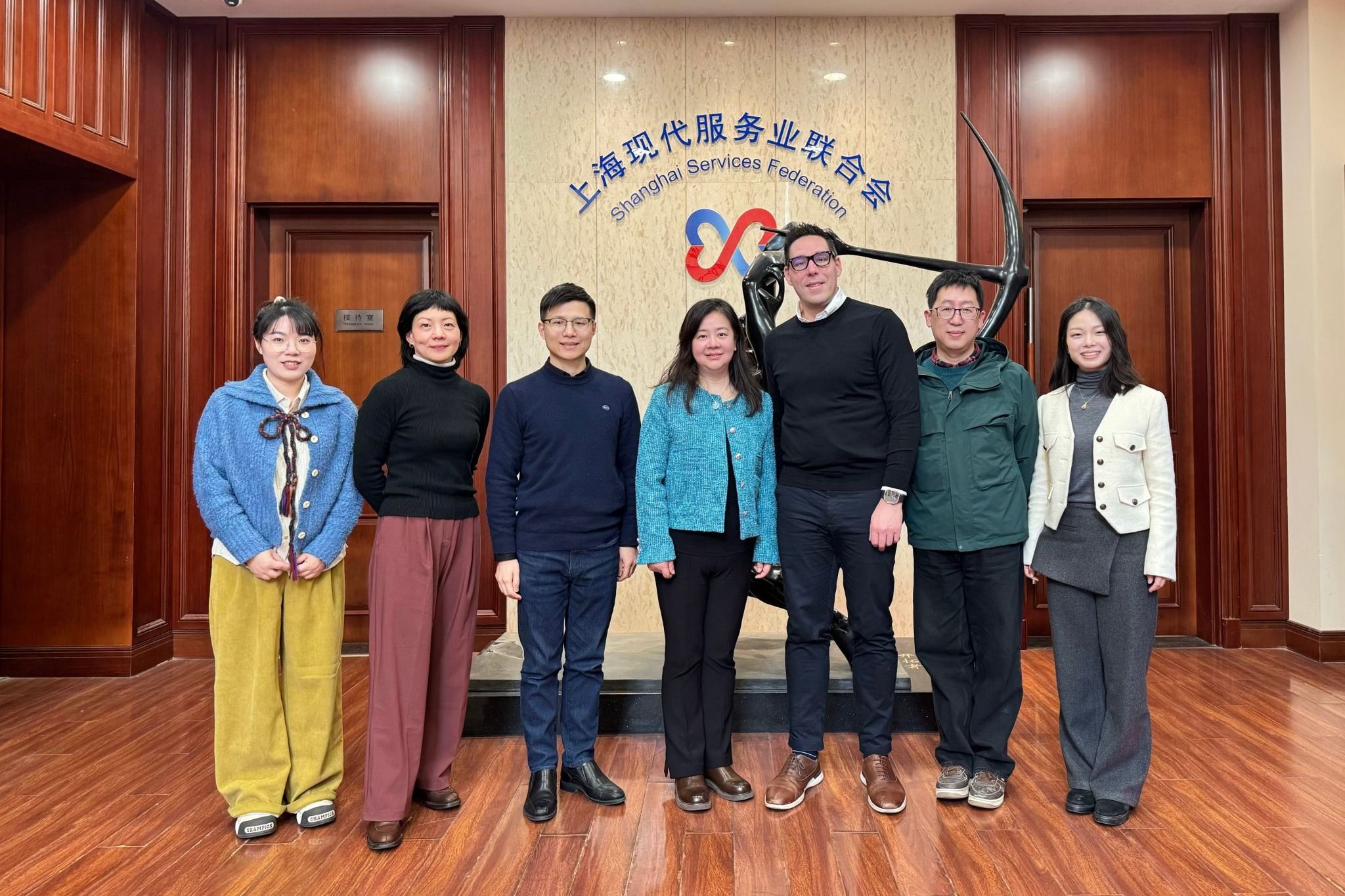
Amid the accelerating wave of digital transformation, the deep integration of education and industry has become a key driver of urban development. On January 15, 2026, Fabien PFAENDER, French Dean of the Sino-European University of Technology of Shanghai University (UTSEUS), and Vice Dean He Zhuoheng led a delegation to visit the Shanghai Modern Service Industry Federation. They were accompanied by Cheng Yanyan, Head of Corporate Relations, and Zhao Ling, Laboratory Director. The UTSEUS delegation held in-depth discussions with Xu Yuncheng, Director of the Federation’s Big Data Center, and her team. Also present at the meeting were Wang Qinqin, Project Manager at the Center, Chen Yuezheng, Digital Service Officer at the Digital Public Service Station (Modern Service Industry), and Liu Ruize, Enterprise Service Specialist at the Center.
Director Xu Yuncheng introduced the functions and key areas of work of the Shanghai Modern Service Industry Federation. The Federation connects nearly 100,000 enterprises across more than 200 service sectors in Shanghai, covering healthcare, real estate, education, ESG, and other emerging fields. Collectively, these industries contribute 78% of Shanghai’s GDP. The Federation plays a coordinating role across industry associations and operates with an enterprise-oriented model, positioning itself as a two-way platform linking government and business, as well as supply and demand.
Its work focuses on three main areas: building communication channels between government and enterprises to help companies access official support more efficiently; working with government bodies to explore compliant and secure pathways for data circulation, enabling data to become both a tradable commodity and a strategic asset; and advancing AI transformation across industries through initiatives such as the annual World Artificial Intelligence Conference (WAIC), CEO forums, industry white papers on AI applications, and ongoing tracking of AI integration across sectors.
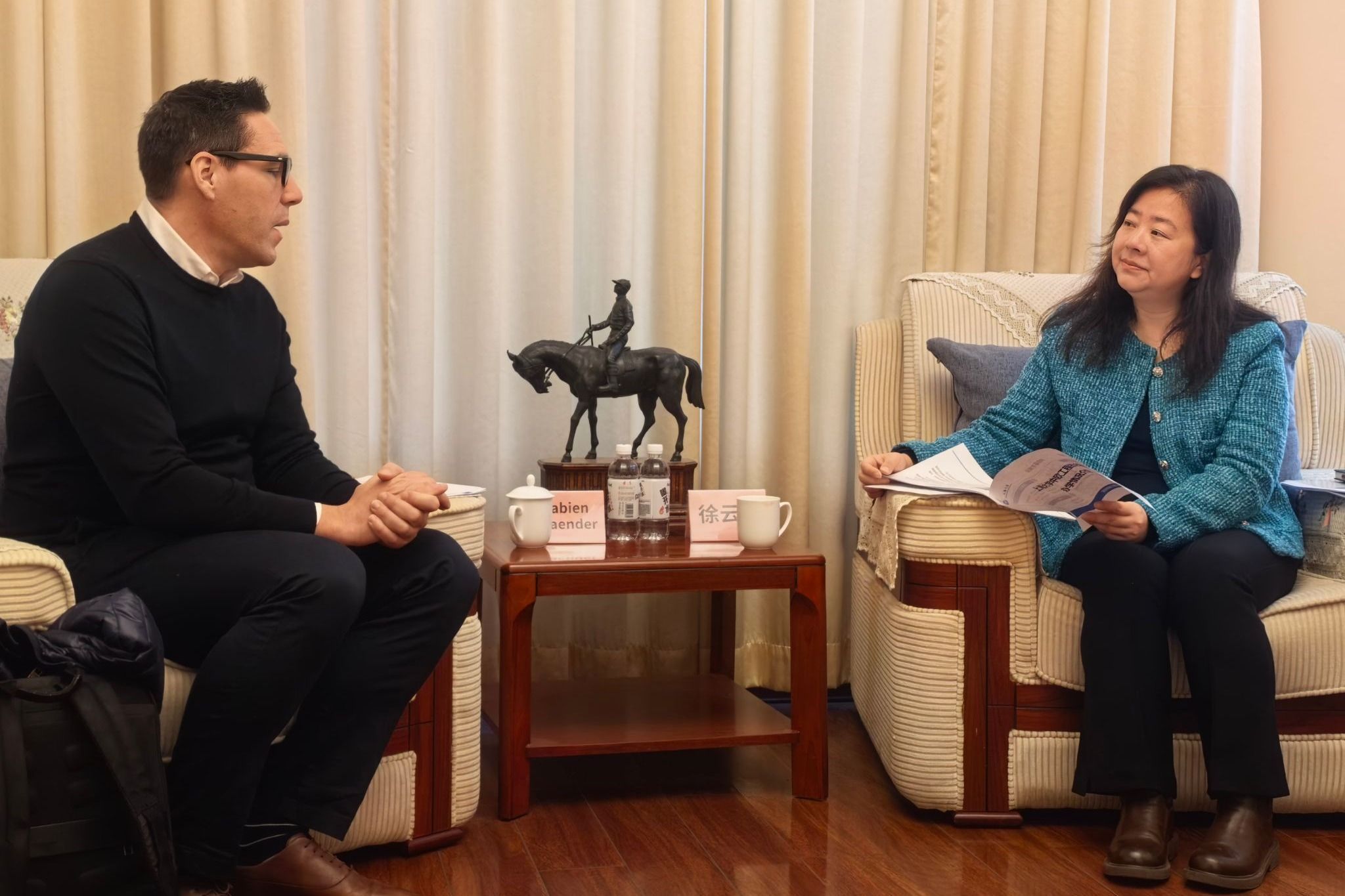
Fabien PFAENDER, French Dean of UTSEUS, introduced the distinctive features of the UTSEUS’ international engineering education model. Unlike more traditional domestic approaches, UTSEUS emphasizes the development of students’ comprehensive ability to solve complex problems by integrating knowledge from technology, humanities, society, and finance, rather than focusing on technical skills alone. He also noted that UTSEUS is currently advancing quality accreditation with the French Commission des Titres d’Ingénieur (CTI), while working with industry partners to further refine its curriculum. At the same time, UTSEUS is actively coordinating the differences between the Chinese and French education systems and combining classroom teaching with research practice. Over the next three to five years, UTSEUS’ plans to expand its master’s programs, further strengthen teaching in AI and data science, and introduce innovation-oriented courses for Chinese students inspired by the French model of project-based innovation training.
Vice Dean He Zhuoheng also presented the history and key characteristics of Shanghai University and UTSEUS.
Both sides found broad common ground, particularly in fostering students’ curiosity about engineering problems and strengthening critical thinking. During the exchange, they explored multiple forms of university-industry collaboration, including internships, innovation projects, and the integration of academic and corporate resources, with the aim of providing students with more valuable development platforms. They also discussed how companies could support initiatives such as the UTSEUS student innovation competition, themed “Rooted in China and Europe, Innovating for the Future,” bringing fresh momentum to UTSEUS’ development.
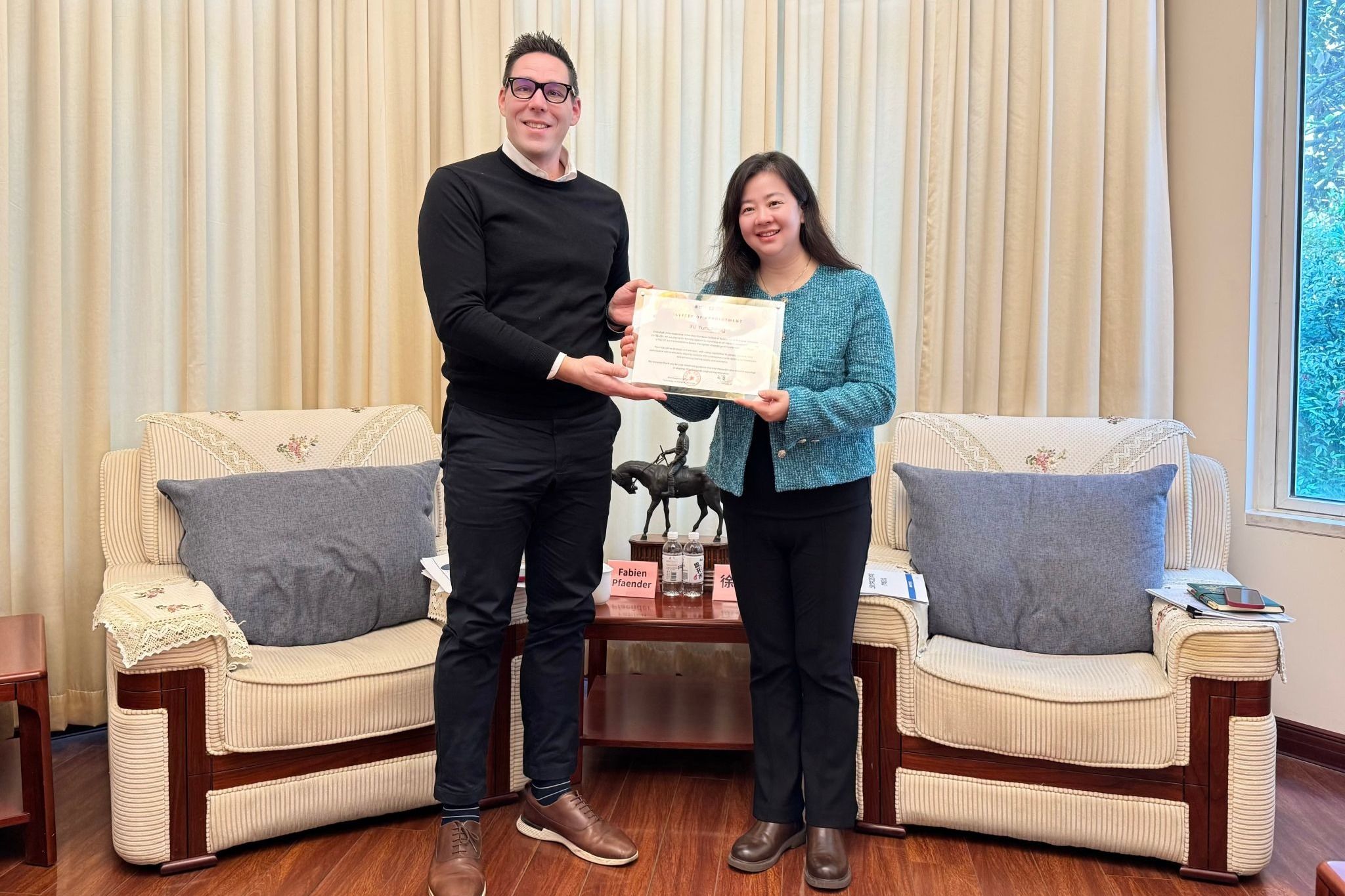
At the end of the meeting, Dean Fabien PFAENDER formally invited Director Xu Yuncheng to play a deeper role in UTSEUS’s talent development efforts and presented her with a letter of appointment as a member of the UTSEUS Joint Management Committee. This appointment will help create new opportunities for faculty and students to connect with corporate resources and engage in practical projects, further strengthening mutually beneficial university-industry cooperation.
This exchange marked a vivid example of the precise alignment between the education chain, talent chain, industry chain, and innovation chain. Looking ahead, both sides will continue to deepen cooperation with a strong focus on talent cultivation, contributing more interdisciplinary professionals equipped with technical expertise, international vision, and innovative spirit to Shanghai’s digital transformation, and injecting new intellectual momentum into the city’s global competitiveness.