A "Sino-French Workshop on Engineering Education in an International Context" was held on May 17 and 18 in Hangzhou.
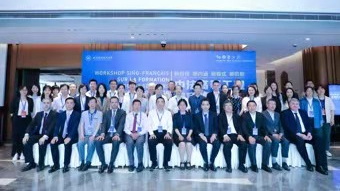
The conference was organized by the Ecole Centrale de Pékin and Beihang University on the occasion of the opening of their new campus in Hangzhou. The organizers had invited representatives of Franco-Chinese institutes - now numbering 18, the majority of which are dedicated to engineering education - who were able to participate on site or remotely via videoconference.
Among these institutes, UTSEUS was invited to present its engineering education program with its specificities.
The French dean of UTSEUS was given the opportunity to describe the general scheme of the education program according to the "two campuses" principle and its models ("3+2.5" mode for engineering education, i.e. 3 years at UTSEUS and then 2.5 years in the UTs; "3+2" mode for master's program). He was also able to introduce the new UTSEUS Master's program in Mechatronics - Control Engineering, which will welcome its first students in September 2021 (2.5-year program in Shanghai after the Bachelor's degree, with a one-semester mobility in the UTs, including two long internships in research and in companies – hence a new “4+2.5” mode) *.
The characteristics of UTSEUS that make this institute unique - a high rate of graduates succeeded in the obtention of their French diploma (UT engineering degree and UT master's degree), as well as a large number of French and international students studied in Shanghai (more than 1000 since 2008) - were mentioned.
Finally, like several of the other speakers, the French dean of UTSEUS emphasized the importance of the link with companies and the role of internships in engineering education, and how this link can also be built with the community of former students - the "UTSEUS alumni" -, numbering 2,535 to date, 73% of whom are based in China and 22% in France. The results of the January 2021 employment survey of all graduates were presented in some detail.
During the opening session of the conference, leaders from the Chinese Ministry of Education - the Deputy General Secretary of the Chinese Scholarship Council (CSC) - and the President of the French “Commission des Titres d'Ingénieurs” (CTI) - provided valuable insight into the role and actions of their organizations, particularly regarding Franco-Chinese institutes.
Let us thank the former and present leaders of Beihang University and the French Ecoles Centrales for this initiative, and let's hope that this kind of conference can be organized again and allow other fruitful exchanges.
* (below the link to the article of the UTSEUS website which explains the UTSEUS master of SHU (July 2019), to be given as a reference :)https://utseus.shu.edu.cn/info/1249/2374.htm